
If you’ve spent any amount of time on any axolotl-themed social media group, you’ve probably seen ‘it’. “It” being the pandemonium any time anyone even thinks about using gravel in their axolotl tank. Have you ever wondered why, exactly, gravel is considered to be so bad? Or about what, if any, substrates are actually axolotl safe? Well then, you’re in the right place!
Silly Gilly Gravel Eater
When I got one of my axolotls Gilly, I took her in from a breeder who was getting out of breeding and needed to find new homes for most of their adult animals. Gilly was a full-grown adult by the time she got to me. She’s always been, and still is, a rather voluptuous lady. But I noticed as soon as I got her that something was off. Her stomach looked downright lumpy.
Sometimes axolotls can look a bit lumpy after a large meal. When that’s the case it usually clears up pretty quickly. But, since she was shipped to me, Gilly had been fasted and hadn’t eaten anything in days. I set her up in her quarantine tank and quickly figured out why she looked extra lumpy. Gilly was full of gravel. Over the course of the next couple of weeks, every time she used the bathroom I’d find more gravel at the bottom of her tank.
Gilly was one of the lucky ones! Luckily, the gravel it seemed her former owner had used wasn’t huge, and Gilly was eventually able to pass it all successfully. This is a picture of her recently, happy, healthy, and gravel free!
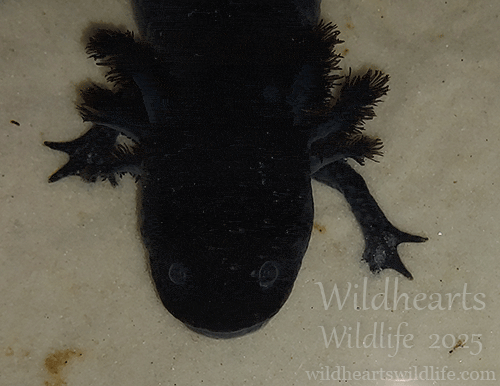
Why Do Axolotls Eat Gravel?
Axolotls are vacuum feeders. They have a unique feeding style, where they essentially suck in their food – muchlike a vacuum. Unfortunately, it’s relatively hard to feed selectively with vacuum feeding. When they suck in their food, sometimes other loose objects in the vicinity are also sucked up. When axolotls suck in things they didn’t intend too, they’ll often times attempt to spit out the non-food items. But they’re not alway so successful, so it’s very common for axolotls to ingest objects they don’t intend too.
And it’s not just gravel that can pose a threat. Axolotls can accidentally ingest pretty much anything small enough to fit inside their mouths. This isn’t such a huge deal if the items they eat are digestible. But things like gravel, rocks, loose aquarium decor, etc, can all pose a very real danger to axolotls. Items that can’t be digested, if they’re too big to pass through them safely, can cause impaction. Impaction poses a very real threat to your axolotls life.
This post contains Amazon affiliate links. If you make a purchase using one of our links, we will receive a small commission, at no additional cost to you. As always, we strive to share only high-quality products that we would feel comfortable using for our own animals. Thank you for your support!
Are There Any Safe Substrates for Axolotls?
If gravel can be so dangerous, you may be wondering if there are any axolotl safe substrates? Good question!
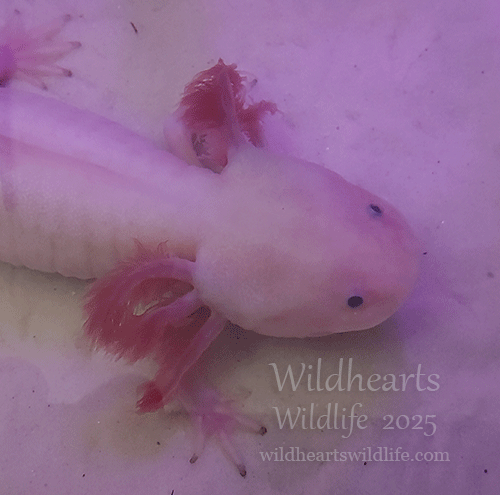
Very fine particle, natural (‘sand’ colored) sand is considered to be the main axolotl safe substrate. Not at all because axolotls won’t eat it! But because, when they do eat it, the particles are so fine that they’re able to harmlessly pass through your axolotl.
I’ve been using this Carib Sea sand for my own adult axolotls. The ‘moonlight sand’ is a very fine particle sand that I’ve personally had good luck with. Make sure you select the ‘moonlight sand’ version, because some of the other Carib Sea substrates are more like gravel and would not be appropriate for axolotls.
I know it can be tempting to go for colored sands. I think my Nova (pictured to the left) would look amazing on black sand! But colored sands are thought to include ingredients that may not be fully axolotl safe. In my opinion, it’s best to err on the side of caution and use natural colored sand only. There are other ways to make your axolotl tank stand out besides colored sand!
The general consensus is that sand is safe for axolotls once they reach the size of 6 inches or larger. With younger/smaller axolotls, most people just stick with bare-bottom aquariums. Having no substrate at all may not look the best, but it makes your tank super easy to clean, and completely eliminates any risk that could be presented by using substrate.
If you’re cool with a bare-bottom tank, this can be used for adult axolotls, too. Axolotls don’t need substrate. They do perfectly fine without it.
If you want the best of both worlds, you can also use things like slate tiles on the bottom of your axolotl tank. This can look nicer than nothing at all, but is similar to having a bare-bottom tank in that it doesn’t involve using any loose substrate.
Any rocks or other decorative items used should always be either larger than your axolotl’s mouth, or else you can use aquarium silicone to stick down decor so your axolotl can’t accidently ingest anything.
The Naturalistic Fallacy
People who sometimes want to use a proven dangerous substrate, like gravel, for axolotls will argue that axolotls ‘in the wild’ would have been exposed to larger, loose substrates. This is true. However, I think it’s important to remember that axolotls in the wild are very close to being extinct.
What’s more natural isn’t always going to be what’s best when it comes to our captive pets. It’s very likely that axolotls in the wild sometimes ingest objects that are too large for them and die.
We should want, and do, better for our pets. There’s no reason to put them in danger for the sake of a nicer looking aquarium. You can make your axolotl an awesome, nature-inspired tank without including substrates and other objects that can potentially kill them.
What I Do With My Axolotls
Up until very recently, I had my own three axolotls in bare-bottom tanks. Not using any substrate makes axolotl aquariums so easy to clean. I never had any issues keeping them in bare-bottom aquariums.
However, recently I decided to switch them to sand. I upgraded their tanks and just decided I wanted to give sand a go, partly because I wanted to attempt introducing some live plants, but mostly just because I thought having a substrate would look nicer. It does. Because I selected a high-quality, very fine sand, I haven’t had any issues using sand for my axolotls. I appreciate the added benefit that adding sand can help keep your aquarium cycle more stable, because beneficial bacteria can live in the sand as well as your aquarium’s filter.
Someday I’d love to try a tile-bottom aquarium for my axolotls. I think especially my leucistic axolotls, Bubbles and his daughter Nova, would look amazing against a darker tile. But that’ll have to be a project for another time.
———————
Unfortunately, Wild Hearts Wild Life has been dealing with content scrappers stealing our content and posting it to other websites without permission. If you’re seeing this article posted anywhere besides wildheartswildlife.com it means you are seeing it on a content scalper’s site. Please consider contacting us to let us know, and stopping by to visit on our actual site! Thank you!